A silver escalin from 1750
After hundreds of copper coins, silver at last. About the escalin: what it was worth, how to read it, what the soil did to it, and a story I made up for it.
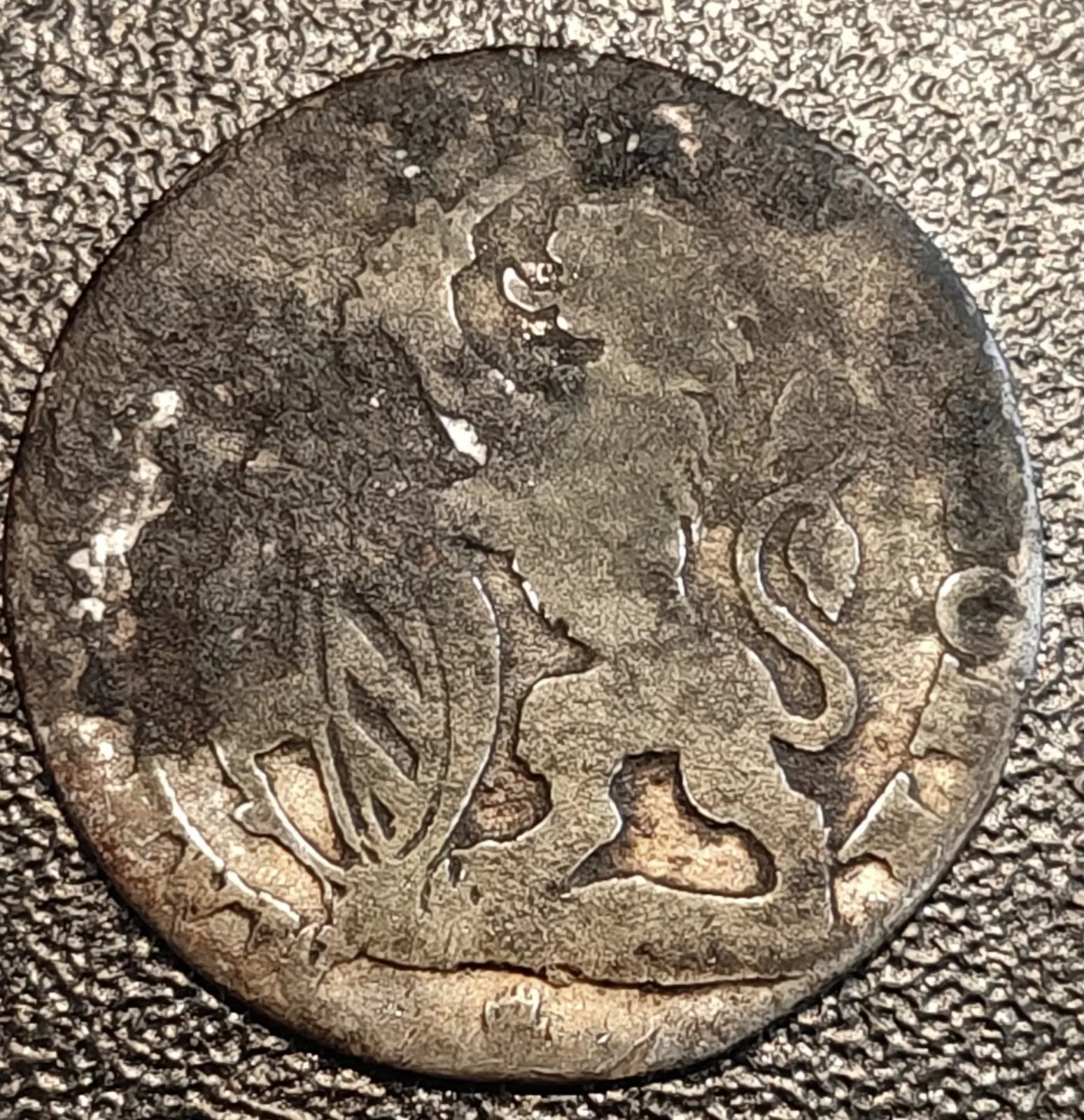
I find copper coins by the hundreds. But silver… that’s something else entirely. My last silver coin was over a year ago when this escalin came up in Bergom (Herselt). And finding a silver coin just does something very special.
You actually see it straight away. Silver has a different shine and a different colour from copper, even with soil still on it. When I saw the coin lying in the ground, I immediately noticed the lion with the shield. I had done a lot of research on other coins and had already come across this escalin online. So I knew 100% it was silver, without even looking at it up close.
And the funny thing is: when I saw it online back then, I thought to myself: my next silver coin, it has to be this one. And it actually happened!
Escalin, schelling, Schilling…
What you called the coin depended on who you were. A French speaker said escalin, here in Flanders people said schelling, a German said Schilling and an Englishman shilling. It’s really the same old word every time.
But careful: the same name doesn’t mean the same coin. In the Spanish period an escalin here was worth 6 stuivers. In the prince-bishopric of Liège it was a coin of 10 patards, half a Liège florin. And in the Austrian Netherlands, where this one comes from, an escalin was 7 stuivers. So if someone back then said “a shilling”, you really had to ask: which one?
Where does the escalin come from?
The first escalins here were struck in 1612, under the Archdukes Albert and Isabella, when the Southern Netherlands were still Spanish. That coin had no lion but a peacock, with the arms of Austria and Burgundy on its chest. That is why it is also called the peacock schelling. It was worth 6 stuivers, was still struck with a hammer and, at 30 millimetres, was quite a bit bigger than mine. It was struck in Antwerp, Brussels, Bruges, Maastricht and ’s-Hertogenbosch, among other places.
After that the escalin stayed in use for almost two centuries, first under the Spanish kings and later under the Austrians. Then in 1749 came the design with the lion that is on my coin.
Seven stuivers in your pocket
In the Austrian Netherlands people counted in florins (guilders) of twenty stuivers. That florin was mostly something to count with: prices and wages were written in florins and stuivers, but your pocket held smaller coins. The escalin sat nicely in the middle.
| Coin | Material | Value in stuivers | Part of a florin |
|---|---|---|---|
| Liard (oord) | copper | ¼ | 1/80 |
| 10 liards | billon (silver with a lot of copper) | 2½ | 1/8 |
| Stuiver (sol) | 1 | 1/20 | |
| Escalin (schelling) | silver | 7 | 7/20 |
| Florin (guilder) | unit of account | 20 | 1 |
More about this currency and its other coins is on the page Florin (Austrian Netherlands).
So why do I find so much copper and so little silver? Simple: a copper liard was small change. Lose one, too bad, but you weren’t going to spend an hour looking for it. An escalin was worth 28 liards. That one you did look for. And silver that stayed behind anyway, or ended up in a drawer, was often melted down later. No wonder the ground is mostly full of copper.
What did it buy?
An escalin was almost a full day’s pay. In the second half of the 18th century a labourer earned about 8 to 10 stuivers a day. One escalin bought roughly five pounds of ordinary bread, or about four litres of beer.
So whoever lost this coin lost almost a day of work. That must have hurt. These figures are rough estimates though: wages and prices differed by year, by town and by trade. Where they come from is on the sources page.
Reading the coin
At first sight you see a lion and a shield. But look closer and there’s a surprising amount on such a small coin.
The lion side. That’s the lion of Brabant. It faces left, holds a sword and carries a shield with the arms of Austria and Burgundy. Below the lion is the mint mark: a little hand for the Antwerp mint, a little lion for the Bruges mint. In 1750 escalins were struck in both cities. Around the edge runs the name of the ruler:
MAR · TH · D : G · R · IMP · G · HUN · BOH · R ·
In full that’s Maria Theresia Dei Gratia Romanorum Imperatrix, Germaniae, Hungariae, Bohemiae Regina, or: “Maria Theresa, by the grace of God Empress of the Romans, Queen of Germany, Hungary and Bohemia”. Almost every word is shortened, otherwise it simply wouldn’t fit.
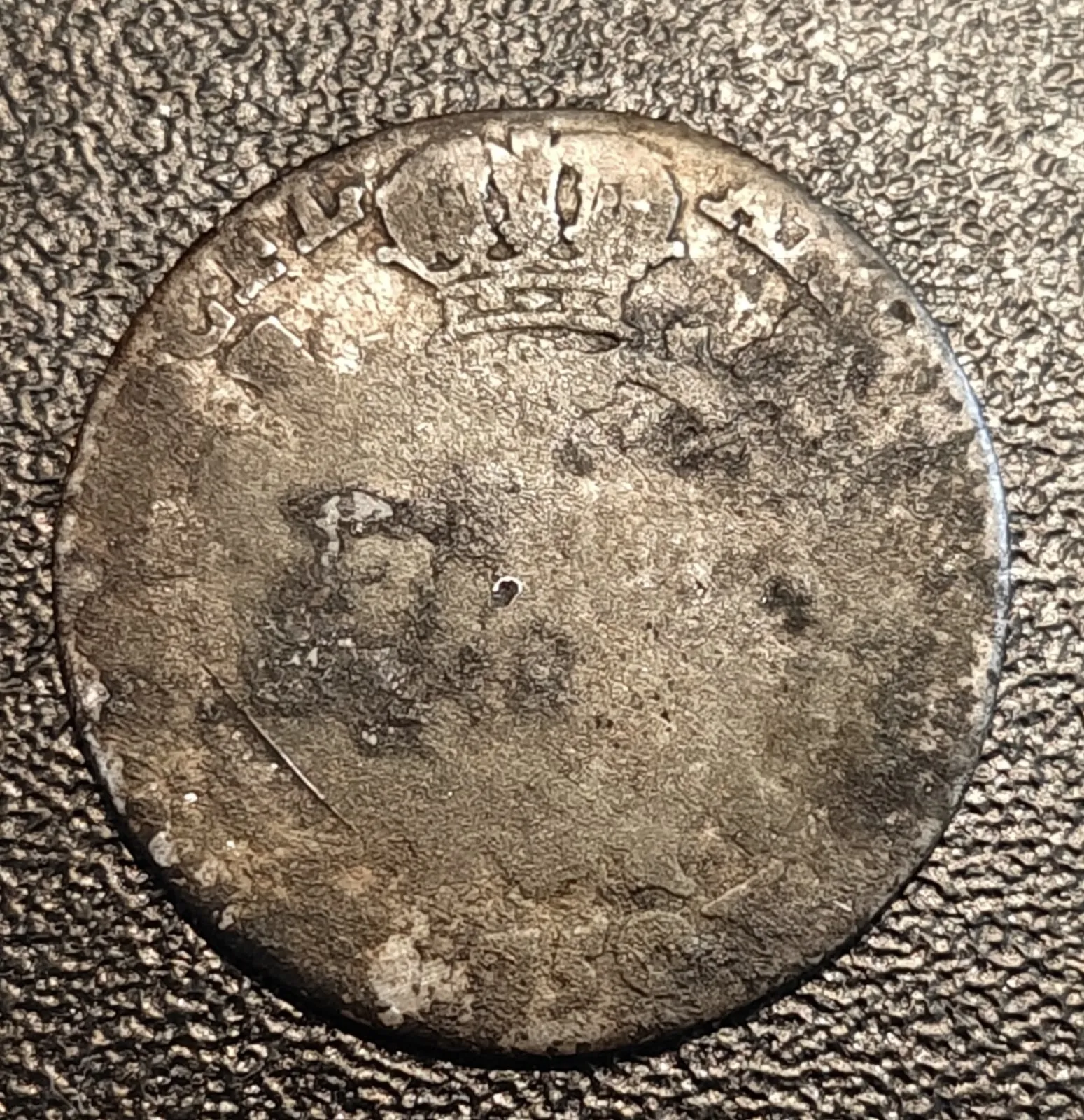
The shield side. Here is a crowned coat of arms with the arms of Hungary, Bohemia, Brabant and Milan. In the middle sits a small shield with Austria and Burgundy. Behind the shield runs the Burgundian cross, a diagonal cross of knotted branches. The legend carries on where the other side stops:
ARCH · AUS · DUX · BURG · BRAB · C · FL · 1750
Archiducissa Austriae, Ducissa Burgundiae, Brabantiae, Comitissa Flandriae: “Archduchess of Austria, Duchess of Burgundy and Brabant, Countess of Flanders”. So together the two sides basically say: this is hers, and these are her lands.
How it was made. The dies were engraved by Jacques Roëttiers. This coin wasn’t struck with a hammer anymore like medieval coins, but with a coin press. That makes it nice and round and the same thickness all over. The edge is decorated too, with a row of dots. An edge like that made it harder to clip or file a bit of silver off the coin without anyone noticing.
Only two years. This design was struck for just two years: 1749 and 1750. In 1749 more than five million came off the press in Antwerp alone. After that a new design already came along.
What the soil did to it
A new escalin weighed 5 grams and was 24 millimetres across. Mine is still 24 millimetres, but only weighs 3.65 grams. So more than a quarter is gone.
Part of that is wear: this coin went from hand to hand for years. But most of it is the soil. The “silver” of an escalin is only just over half silver (53.5%). The rest is mainly copper, and copper breaks down in the ground a lot faster than silver.
The strange thing about this coin is that it’s only partly corroded. Part of the bottom still looks almost new, while the top and the left side are heavily corroded. Probably not every part of the coin lay in the same conditions, because of moisture or something else in the soil touching it. I chose not to clean that side aggressively. That would only damage the coin more.
What was going on back then
This escalin was struck in turbulent times. Maria Theresa inherited the Habsburg lands in 1740, and in the years after, French troops occupied much of the Austrian Netherlands. Only with the Peace of Aachen in 1748 did they go back to Austria, and a year later this design came out. I’ll write separate articles about Maria Theresa and that war later.
How does a coin like this end up in a field?
When I find something, I like to make up a story to go with it. We will never know the real story of this escalin, so I make one up myself. What follows is fiction: I just do this because it’s fun. One thing is true though: on the same field I find a lot of horse material from that period.
For this coin, I like to believe the following story.
The year is 1750, December, unusually cold for the time of year. Half past seven in the morning. Jos, the farmer who lives on the farm nearby, was already busy feeding his horses.
It was difficult to see the horses because of the fog, but once they heard Jos carrying the bucket of oats he had grown himself, they came to him.
Although Jos was used to doing this every day, he still had a weird feeling about today. Yesterday he had heard a strange noise coming from the castle nearby, a couple of hours before the first rooster crowed to wake him up.
The Merode castle in Westerlo was famous in the region, so others must have heard a noise like that as well, right? But at the breakfast table his son and wife hadn’t mentioned anything about it. So it must have been something else.
Jos was giving his last bag of oats to his horses when a carriage came racing from the distance.
Jos lived next to the old dreef, the lane the Merode family often used to get to Averbode, and from there on to Diest or through a passage towards Aarschot. So a carriage coming down the dreef was nothing unusual.
A bit further, where you entered the forest of the Merodes, the Hertberg, that passage was even fully private, owned by the family itself. The local townspeople had to use a bumpy mud track to get past it, and entering the forest itself was forbidden.
But Jos was one of the few allowed to live near the forest and use its land, in exchange for breeding horses for the Marquis of Westerlo.
The carriage seemed to be in a hurry and had no intention of stopping. Until …
It came to an immediate halt right next to where Jos was standing.
Jos noticed the Merode coat of arms on the carriage and knew he had to act as professionally as possible. He took off his cap and held it to his stomach before the door opened.
When it did, there was a quick gesture and a shout from the carriage: “HIER!” Here!
Jos went to the carriage without a question. He could hear the urgency in the man’s voice.
The next words were something Jos would never forget: “Keep them away.”
Keep them away?? Jos wondered.
The man was getting more and more tense and had no intention of giving an explanation. He knocked on the roof to let the driver know the carriage had to get back to speed as soon as possible.
One more time the man repeated the words, now with a more worried, silent whisper, as if he was asking a favour: “Keep them away.”
As the carriage left, the man reached into his pocket and threw Jos the one coin still in there: a silver escalin, from that same year.
It flew into the air, but because of the speed of the carriage Jos only saw a silver flicker, caused by the sun that was rising.
Very confused about what had just happened, Jos watched the carriage disappear into the distance.
Just as the coin fell into the grass next to the horses, another loud sound came from the distance. Another carriage…
Jos wanted to go and grab the coin, but first he looked back at the sound. When he looked back at the ground, he couldn’t find it right away. It was lying somewhere in the grass.
The second carriage stopped by Jos. Had a carriage come past here? And which direction did it go? Jos pointed the other way, and off they went.
Afterwards Jos stood there for a long time, among his horses in the fog. What were those men after? And who was he supposed to keep away?
So this coin tells a big story, but no one truly knows what happened that day.